Peak Soaring | Benjamin Bachmaier | Discover it Now

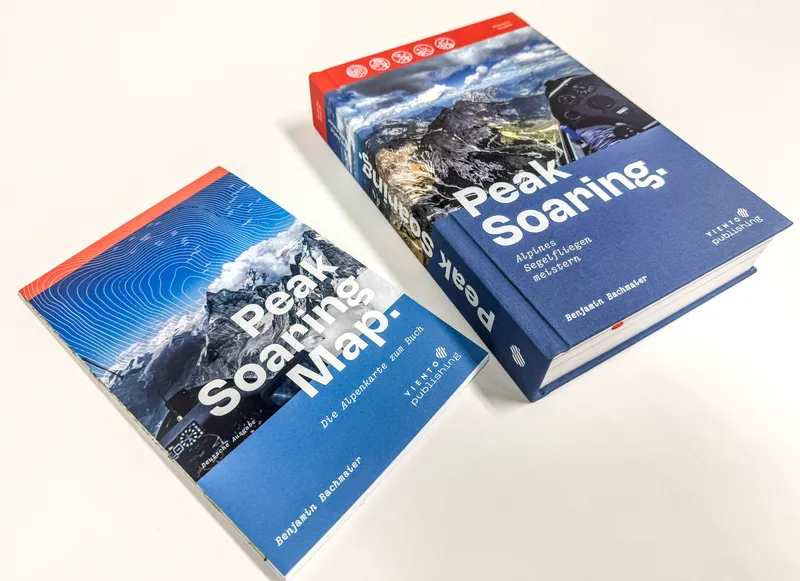
With Peak Soaring, Benjamin Bachmaier has created a work that is already being hailed as the new “Standard reference for mountain flying.” If you fly in the mountains — or plan to start — this book belongs both in your cockpit and on your reading list. Packed with practical explanations, clear visual models, and deep meteorological insight, Peak Soaring sets a new benchmark for anyone who wants to truly understand thermals, wind, and terrain. You don’t have your copy yet? It’s available now!
In the following excerpt, you’ll get a glimpse into the book’s remarkable level of detail: How does wind influence mountain thermals? What role do windward flow, lee-side dynamics, and slope geometry really play? And why can even strong updrafts become treacherous once the wind begins to shift them? For the English edition of the book, Clemens Ceipek – well known from “Chess in the Air” – joined the project. His blend of flying experience and outstanding translation expertise proved immensely valuable.
More insights, practical how-to tips and in-depth background knowledge await you in the full book – now available with free shipping for a limited time in the Viento Store ⬇️
Taking Account of the Wind on the Mountain – Excerpt from the Book »Peak Soaring« by Benjamin Bachmaier
We’ve already discussed how mountain thermals are influenced by the terrain, solar heating, the neighborhood, and the snow cover. Another decisive factor is the wind. While we already considered the wind in the context of “From where does the mountain get its air?”, it deserves a separate treatment here, particularly when it is stronger.
The interaction between wind and thermals on a mountain is best understood by examining three distinctive cases: windward-supported thermals, lee thermals, and thermals at a slope parallel to the wind. The wind can be a pressure-gradient flow towards the heat low (for example the valley wind), the synoptic wind flowing through the terrain, or a combination of both.
Case 1: Windward Thermals
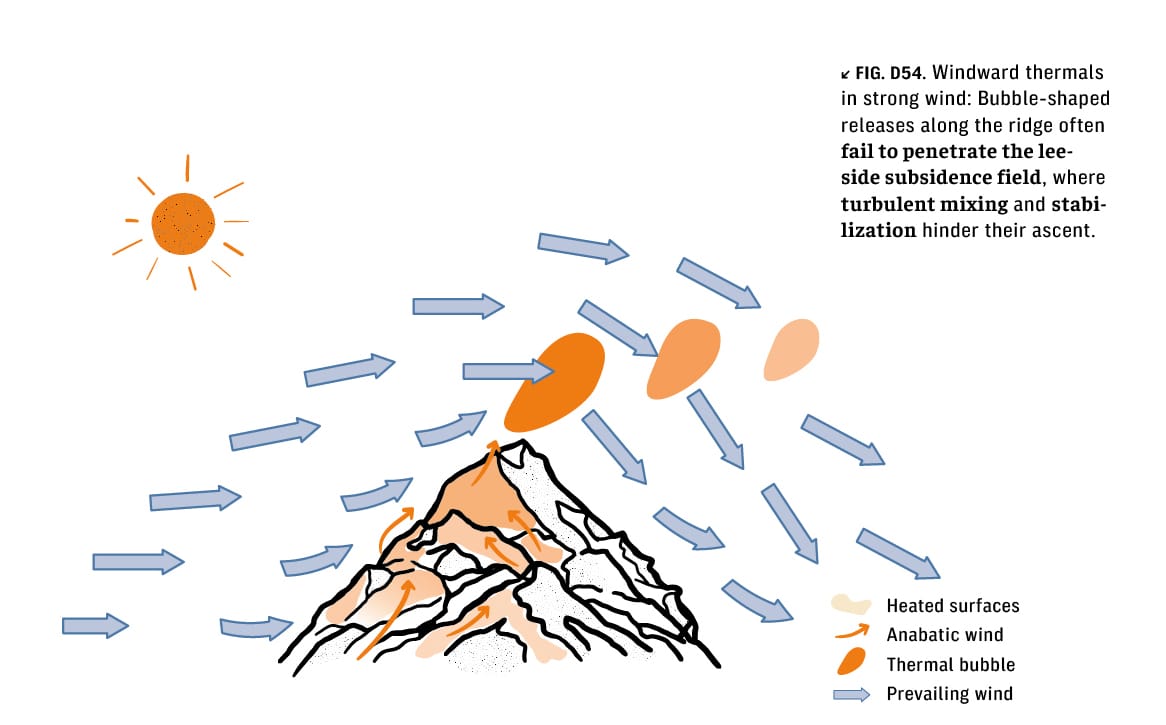
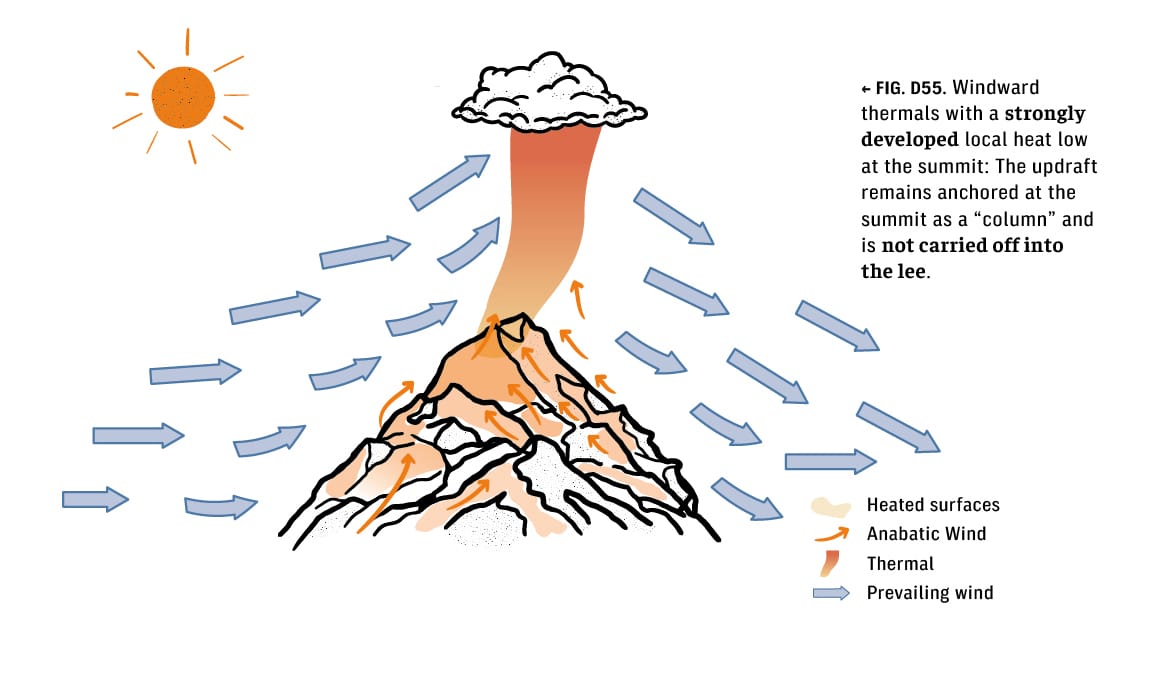
We speak of windward thermals when the wind approaches a mountain from the same direction from where it receives the greatest heating, i.e., when sunlight and wind come from the same direction. On such slopes, thermal slope wind and dynamic ridge wind reinforce one another, producing a relatively broad, strong upflow field along the slope. The thermals usually detach at the highest points of the terrain, i.e. at the ridge or summit.
However, a sharp terrain step in front of the mountain may also trigger a release there such that the core of the thermal rises in front of the main ridge. If this happens, the thermal tends to draw heated air away from the main slope, weaking the upslope wind and possibly causing sink. Especially for paraglider pilots it is important to recognize such a situation early and leave the main slope before experiencing significant altitude loss.
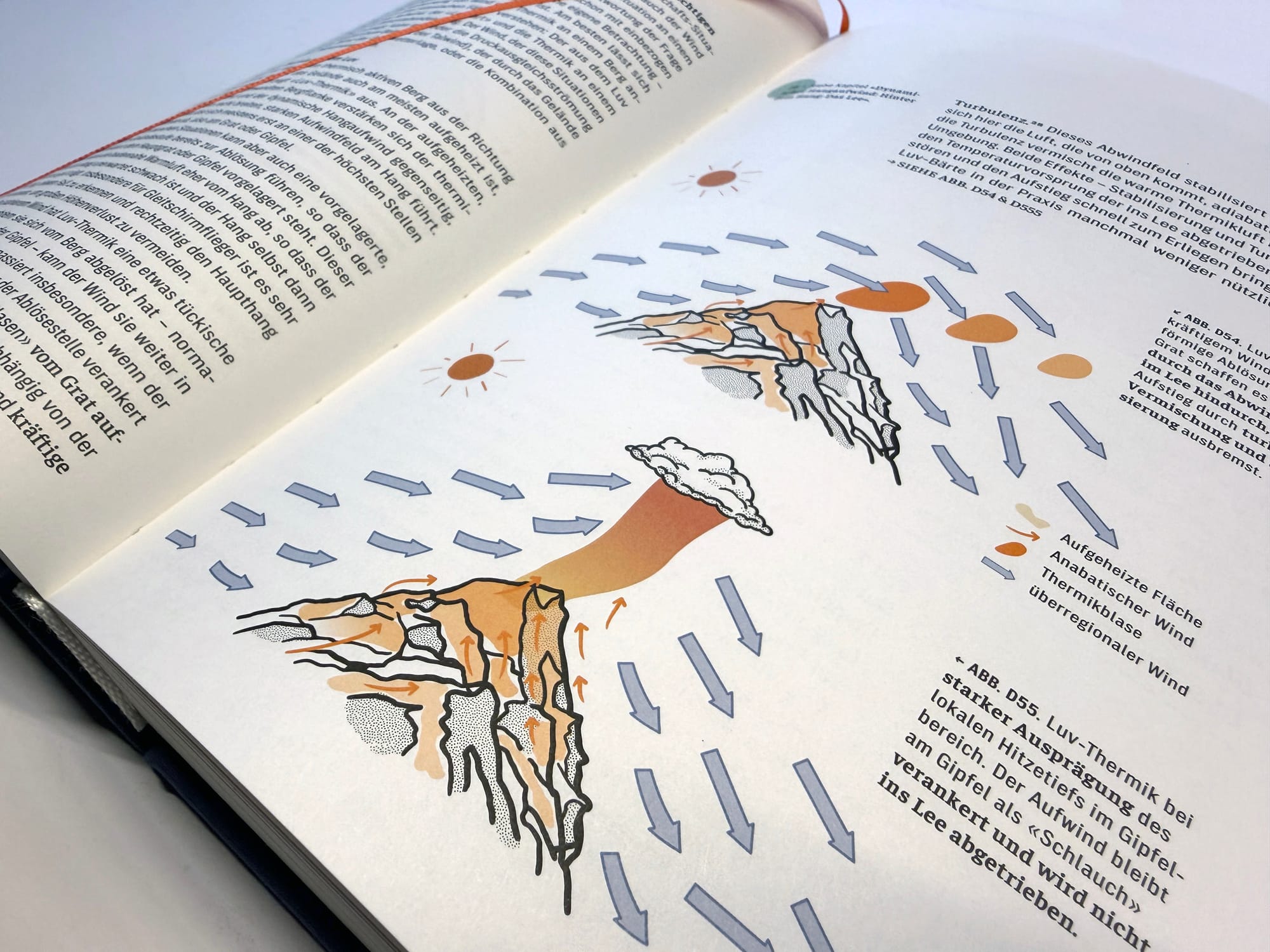
In stronger winds, windward thermals have a somewhat problematic feature: once they have detached from the mountain—normally at the main ridge or summit—the wind can displace them into the lee. This occurs especially when the updraft is not a continuous column, which remains attached to its release point, but instead rises as separate bubbles from the ridge. On the lee side of the mountain there is usually, depending on wind strength, an area of significant sink and strong turbulence. The sinking stabilizes the air mass (because descending air warms adiabatically), and the turbulence mixes the warm thermal air with its cooler surroundings.Both effects—stabilization and turbulence—can destroy the thermal’s temperature surplus and quickly bring its climb to an end. In practice, therefore, windward thermals are sometimes less useful than hoped.
Case 2: Thermals in the Lee
Of course, the slope with the greatest heating is not always the one facing into wind. Often the wind strikes the mountain from one direction, while the best heating conditions are on the other side—in the lee. Many mountain pilots are uneasy in this situation: should they make use of the windward slope lift, or gamble that the lee side will offer not only turbulence and heavy sink, but also a somewhat notorious, strong lee thermal?
To build confidence that even in stronger winds the lee side of a mountain can be a valuable thermal source, let us consider an example: a strong northerly wind flows over a mountain while the sun shines from the south where heating conditions are good: large terrain volume, good sun exposure, and dry rock surfaces.
The strong wind creates dynamic ridge lift along the north side (depending on stratification it may not always be usable though). Even the north side usually receives at least some sunshine during the day, therefore the air can also pick up a modest amount of heat anabatically. By the time the air reaches the ridge, it already has some temperature advantage over its surroundings. If this advantage is strong enough, the air could detach here and form a windward thermal as described earlier. In our example, however, the heating of the north slope has been insufficient to destabilize the air sufficiently, so the wind carries it down the lee slope. During its descent it not only warms adiabatically (with decreasing altitude), but it also gains further heat from the warm, sun-exposed terrain. On this wind-forced downward path the air’s temperature surplus over its environment can thus further increase substantially.
Do you want to know how the story continues? Then get “Peak Soaring” by Benjamin Bachmaier at the VIENTO store or from your trusted bookseller.
WeGlide. Innovations for the sport. Help us advance gliding:
If you would like to receive articles like this directly via email, you can sign up in your profile.